

The Macro Pulse | July 20th, 2026
Global growth has not rolled over, but breadth has been narrowing materially.
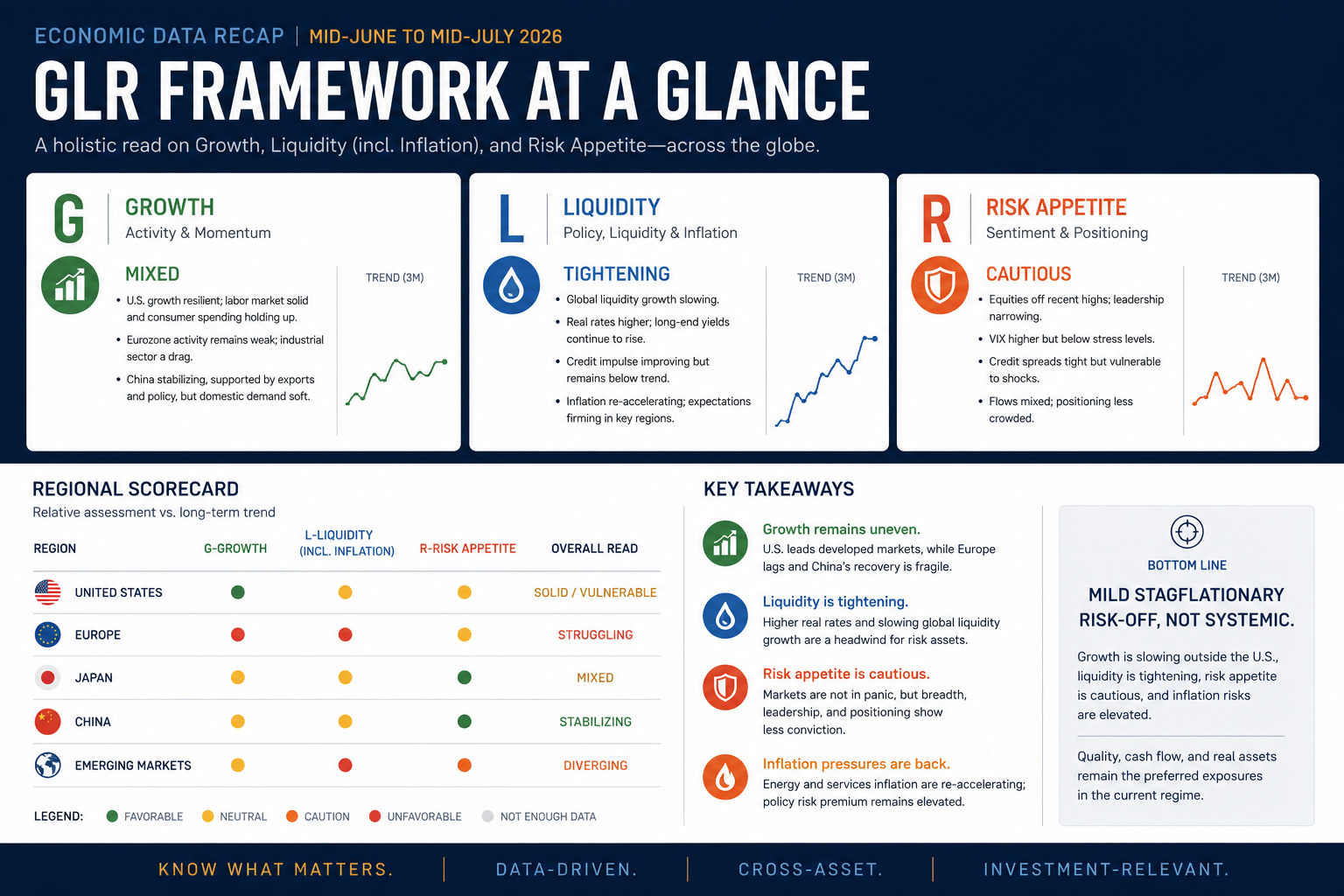
Global growth has not rolled over, but breadth has been narrowing, materially. The U.S. remains the strongest major DM economy on realized activity, but the composition is increasingly uneven; Europe is weak but showing pockets of stabilization; China is externally strong and domestically soft; Japan is improving cyclically but remains constrained by policy and imported-energy dynamics; and the global inflation picture is becoming much less synchronized.
1. Macro growth: still positive, but increasingly narrow
United States
The U.S. data flow over the last month has been better than the headline growth narrative, but weaker than the market’s strongest cyclical interpretation.
The positive side is clear. June manufacturing indicators stayed expansionary: S&P Manufacturing PMI was 55.7 and the ISM manufacturing index came in at 53.3. Services remained solid around 54. The final Q1 GDP print was revised up to 2.1% from 0.5%, while personal income rose 0.7% and personal spending 0.7% in May. Retail sales later remained firm, with the control group up 0.5% in June. Initial claims stayed low around 215K.
But the breadth is poor. June payroll growth was only 57K versus 110K expected; ADP was also soft at 98K versus 113K expected. Housing remains visibly constrained: new-home sales fell 7.3%, pending-home sales fell 5.4%, and mortgage rates stayed around 6.6%. Industrial production was essentially flat in June. The Chicago Fed National Activity Index also slipped below zero.
So the U.S. signal is:
