

The Morning Signal | July 19, 2026
The dominant macro transition is from a benign disinflation narrative toward a contained stagflationary shock, with stress concentrated in AI leadership rather than broad risk assets.
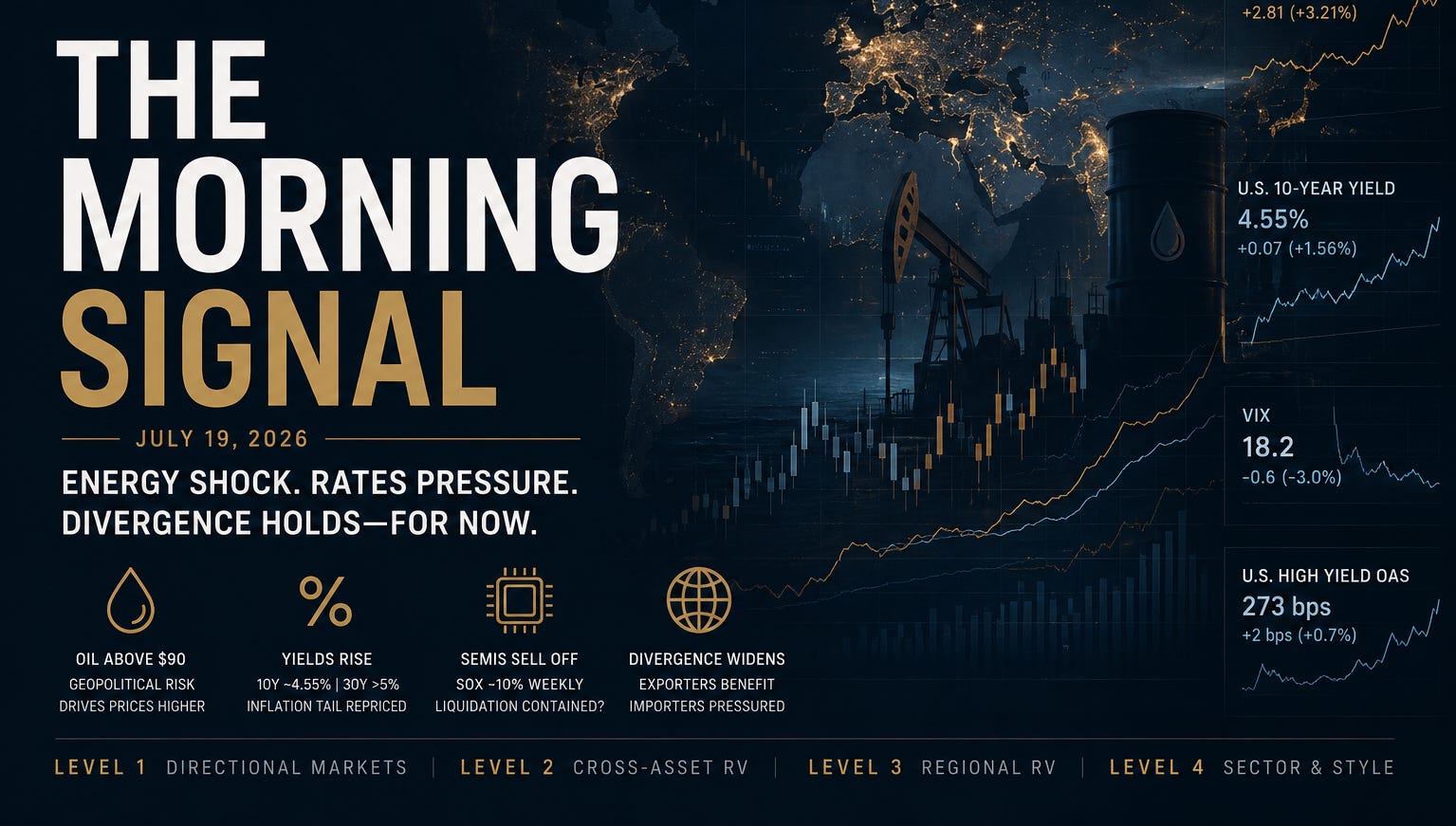
The Core Tape: Markets are repricing inflation risk through energy and long-duration rates faster than they are repricing growth risk.
The defining development is the combination of renewed geopolitical energy risk, higher long-end yields, and a sharp unwind in semiconductor leadership.
Cross-asset confirmation remains incomplete. Oil and yields confirm the inflation impulse, while credit and broad volatility have yet to confirm systemic stress.
The move remains contained rather than systemic. Markets are repricing crowded and duration-sensitive exposures rather than indiscriminately liquidating risk.
Overall: The prevailing regime remains one of positive but narrowing growth, neutral-to-negative liquidity, and deteriorating but not broken risk appetite. The principal propagation risk is the interaction between higher energy prices, tighter financial conditions, and elevated equity valuations. The preferred portfolio posture remains quality, broader market breadth, cash-flow generation, energy scarcity beneficiaries, and relative-value exposures over high-beta directional risk.
Top-Down Macro Environment
Growth: Positive but narrowing
Current read: Global activity continues to expand, led by the U.S., while breadth (
G.BR) continues to deteriorate beneath the surface.What’s changed: The energy shock introduces a new headwind to real incomes and increases the risk that resilient consumption begins to soften over the coming months.
Confirmation/conflict: Business investment, AI capex, and selected manufacturing indicators remain constructive. Housing, portions of industrial production, and consumer-sensitive sectors remain noticeably weaker.
Trading implications: Own growth selectively through quality, infrastructure, and cash-generative businesses rather than broad cyclical beta.
G-Growth Score: +0.50, deteriorating.
Liquidity: Neutral-negative
Current read: Nominal financial conditions remain restrictive despite recent progress on realized inflation.
What’s changed: Higher oil prices are tightening financial conditions through upward pressure on long-end yields and inflation expectations.
Confirmation/conflict: Higher Treasury yields, firmer European rates, and stronger energy prices point toward tighter conditions. Credit markets, however, have yet to reflect meaningful stress.
Trading implication: Maintain caution toward long-duration growth and rate-sensitive sectors while retaining intermediate-duration Treasuries as portfolio insurance.
L-Liquidity Score: -0.50, stable to deteriorating.
Risk Appetite: Incremental deterioration
Current read: Risk appetite has weakened materially within crowded technology leadership but remains resilient elsewhere.
What’s changed: Semiconductor weakness is now interacting with a genuine macro catalyst rather than remaining a purely valuation-driven correction.
Confirmation/conflict: Equity concentration has deteriorated sharply while credit, volatility, and market functioning remain relatively orderly.
Trading implication: Favor relative-value positioning over outright bearish exposure until credit and volatility begin confirming broader stress.
R-Risk Appetite Score: -0.50, with downside-convexity.
Cross-Asset Market Views
Overall Market View: The regime remains one of concentrated stress rather than generalized liquidation. The critical question is whether weakness broadens beyond semiconductors into credit, market breadth, and cyclical sectors.
Level 1: Directional Markets
The dominant cross-asset impulse is inflationary rather than recessionary. Commodities and long-end rates are repricing higher while equity weakness remains concentrated rather than indiscriminate.
Equities: Leadership correction, not broad collapse
Semiconductor leadership continues to unwind aggressively.
Equal-weight and cash-flow-oriented equities remain relatively resilient.
The critical distinction remains concentrated positioning stress versus systemic weakness.
Rates: Long-end yields remain under upward pressure
Higher oil prices and firmer inflation expectations continue to pressure duration.
Key cross-asset signal: Markets are pricing the inflation risk more aggressively than the associated growth risk.
FX: Relative opportunities dominate
Energy-importing currencies remain vulnerable to a deterioration in terms of trade.
Commodity-linked currencies remain the cleaner relative expression if crude stays elevated.
Commodities: Energy remains the macro fulcrum
Oil is reflecting physical supply risk rather than purely speculative positioning.
Higher energy prices transmit into the broader macro regime through inflation expectations, real household income, corporate margins, and monetary-policy expectations.
Credit & Volatility: No systemic confirmation
Credit remains orderly.
Volatility has risen only modestly relative to the magnitude of the semiconductor selloff.
The absence of broad credit stress argues against interpreting the current move as generalized recession or liquidation pricing.
Overall Regime Read: Contained stagflationary repricing.
Level 2: Cross-Asset Relative Value
The defining feature of the tape is concentrated semiconductor weakness without signs of broader cross-asset contagion. The current evidence points toward a positioning and valuation adjustment rather than a generalized deterioration in the macro risk environment.
Semiconductors versus the broader market
Observation: AI leadership has experienced an unusually sharp correction.
Interpretation: Positioning and valuation are adjusting faster than underlying macro fundamentals.
Confirmation signal: Credit spreads remain contained and broader equity breadth holds.
Change of view: Meaningful deterioration in high-yield credit, regional banks, and broader market breadth would indicate that the correction is propagating beyond concentrated technology exposure.
Oil versus gold
Observation: Oil has repriced materially while gold has been comparatively restrained.
Interpretation: Markets are treating the geopolitical shock primarily as a physical supply and inflation event rather than a systemic financial-stability event.
Confirmation signal: Stable funding markets, contained credit spreads, and moderate broad-market volatility.
Change of view: A decisive gold breakout accompanied by wider credit spreads and rising volatility would indicate a broader flight toward safety.
Rising yields versus resilient equities
Observation: Long-end rates have risen without a proportional decline in broad equities.
Interpretation: Equity markets have yet to fully absorb the implications of higher discount rates, or alternatively expect the rise in yields to prove temporary.
Confirmation signal: Continued resilience in equal-weight indices and earnings expectations.
Change of view: Sustained multiple compression outside technology would indicate that the rates shock is broadening into a generalized equity repricing.
Level 3: Country and Regional Relative Value
The principal geographic fault line is increasingly defined by energy exporters versus energy importers, layered on top of significant differences in underlying growth resilience.
United States: Preferred
U.S. growth remains the strongest among major developed economies, but elevated valuations and higher long-end yields argue for quality and broader market exposure over concentrated leadership (i.e., technology).
The principal risk is that higher energy prices and tighter financial conditions begin to weaken consumption before the investment cycle can broaden sufficiently to compensate.
Europe: Underweight
Europe faces the most difficult combination of:
Weak domestic growth
Renewed energy inflation.
Higher energy prices threaten real incomes and industrial margins, while simultaneously complicating the policy outlook and the ability of the ECB to dampen the blow through policy easing.
The key monitoring signal is whether higher energy costs begin to appear in weaker forward activity indicators alongside renewed pricing pressure.
Japan: Neutral
Domestic cyclical improvement remains intact but is increasingly challenged by imported energy costs and currency sensitivity.
The principal risk is a renewed deterioration in the terms of trade that weakens household purchasing power and complicates the policy normalization process.
Asia: Selective
China’s external sector remains considerably stronger than domestic demand, while semiconductor-heavy Asian markets remain vulnerable to continued positioning adjustments.
The preference remains selective exposure to external and industrial strength rather than broad regional beta.
Emerging Markets: Prefer commodity exporters
Commodity exporters continue to benefit from stronger terms of trade, while energy importers face pressure through inflation, external balances, and domestic financial conditions.
The relative trade remains more compelling than a broad directional EM view.
Level 4: Sector & Style
The rotation continues to favor current cash flows and scarcity beneficiaries over long-duration growth. The critical question is whether this remains an orderly change in leadership or develops into broader de-risking.
Leadership: Energy, defense, infrastructure, quality
These exposures benefit from stronger nominal cash flows, structural fiscal support, and reduced sensitivity to lower discount rates.
Energy is the clearest beneficiary of a higher nominal regime.
Defense + Infrastructure can retain unusually durable demand visibility because their revenue drivers are tied more to Policy and capex cycles, rather than discretionary household spending.
Quality fits the same regime, but from a different angle.
Strong balance sheets, high free-cash-flow conversion, and pricing power matter more when the cost of capital is elevated and growth becomes less broad (as is happening right now).
The common thread across this leadership group is resilience in cash flow generation without requiring a rapid decline in rates to support the thesis.
Laggards: Semiconductors, speculative growth, housing
These remain most exposed to elevated expectations, higher discount rates, and tighter financial conditions.
Semiconductors are still vulnerable because the fundamental AI capex story can remain intact while valuations and positioning compress,
This is particularly true when the market stops rewarding long-duration earnings at prior multiples (as is happening right now).
Speculative growth is even more sensitive to this adjustment because much of its value depends on distant cash flows and continued access to favorable financing.
Housing faces a more direct constraint: elevated mortgage rates and affordability pressure will continue to limit demand even if headline economic growth remains positive.
Style: Prefer Quality over Duration-sensitive stocks
High free-cash-flow businesses remain better positioned than assets whose valuations depend heavily on distant earnings and lower rates.
In the current regime, investors are being compensated more clearly for owning present earnings, balance-sheet strength, and capital discipline rather than being rewarded for underwriting aggressive long-term growth assumptions. The latter had been a pervasive, persistent, and defining narrative of the bull market narrative that was in play for the past several years.
This does not mean abandoning secular growth, however.
It means being more selective about the price paid for it.
Until either (1) real yields fall or (2) earnings revisions broaden materially, the Quality factor should retain an advantage over pure Duration-sensitive equity exposures (i.e., the “bond surrogate” stock groups).
Cyclicals vs. Defensives: Favor selective cyclicals
Infrastructure, defense, and energy remain preferable to consumer-sensitive cyclicals.
This is not a conventional “cyclical-over-defensives” call.
It is a preference for sectors with: (A) direct nominal cash-flow support + (B) structural demand. The distinction matters.
Traditional cyclicals, such as consumer discretionary, lower-quality industrial demand, and housing-related industries remain more exposed to tighter financial conditions and softer real income growth.
By contrast, energy, defense, and infrastructure stocks can continue to benefit even if aggregate growth slows, because their demand drivers are less dependent on broad consumer strength.
Rate-sensitive assets: Remain cautious
Housing, REITs, and leveraged growth remain vulnerable if long-end yields continue rising.
A sustained decline in real yields would be required to materially improve the tactical view.
Until then, refinancing costs, cap-rate pressure, and weaker affordability remain meaningful headwinds across rate-sensitive sectors.
The key distinction is between (A) assets that merely need stable rates and (B) those that require materially lower rates to justify their current valuations. The latter remain more fragile in a regime like this where inflation risk has re-entered the discussion and central banks have less room to ease aggressively.
Thematic
AI & Semiconductors: Tactical correction, structural thesis intact (for now?)
The AI investment cycle remains fundamentally constructive, but positioning and expectations have moved ahead of the market’s willingness to capitalize future growth at previous valuations.
Leadership is undergoing a significant valuation and positioning adjustment.
Upcoming earnings and capital-spending guidance are the key fundamental catalysts.
Price reaction to strong results will be more informative than the headline results themselves.
Monitor market breadth, capex guidance, earnings revisions, and whether semiconductor weakness spreads into adjacent technology exposures.
Change of view: Persistent selling despite strong earnings and sustained capex guidance would indicate that the adjustment has further to run. Stabilization on negative news would suggest positioning pressure is becoming exhausted.
Energy & Geopolitics: Primary macro transmission channel
Energy is the principal mechanism through which geopolitical risk can alter the broader growth, inflation, and policy regime.
Physical supply concerns remain the primary driver.
Higher oil prices feed into inflation expectations while reducing household purchasing power and pressuring corporate margins.
Monitor shipping activity, physical crude differentials, inventories, and signs of sustained supply disruption.
Change of view: Credible de-escalation accompanied by normalized shipping flows and a sustained decline in crude would materially weaken the stagflationary thesis.
Defense & Infrastructure: Structural support remains intact
Fiscal and geopolitical priorities continue to provide a durable demand backdrop that is less dependent on the household cycle.
Secular demand remains strong.
Earnings are less dependent on lower interest rates than traditional long-duration growth exposures.
Monitor fiscal commitments, procurement activity, and changes in government spending expectations.
Change of view: A material reduction in fiscal commitments or evidence that valuations have moved substantially ahead of earnings would weaken the relative preference.
Consumer: Incremental deterioration
Higher energy prices increase the risk that an already uneven consumer backdrop becomes a more meaningful constraint on growth.
Housing remains constrained by elevated financing costs.
Higher fuel and energy expenses pressure real disposable income.
Monitor retail spending, consumer confidence, delinquency trends, and discretionary-sector earnings.
Change of view: Falling energy prices combined with improving real wages and broader consumption growth would reduce the downside risk.
What’s at an extreme
Semiconductor leadership: The sector is experiencing one of the sharpest corrections of the current AI cycle despite limited evidence of a comparable deterioration in underlying end demand. The gap between fundamental expectations and price behavior points toward a significant positioning and valuation adjustment.
Real rates and equity valuations: Restrictive real yields remain an unusually demanding backdrop for elevated long-duration equity valuations, increasing sensitivity to any disappointment in earnings or growth expectations.
Oil versus broad volatility: Energy risk has repriced considerably more aggressively than implied broad-market risk, highlighting the market’s current view that the shock remains concentrated rather than systemic.
Regional terms-of-trade dispersion: The widening divide between commodity exporters and energy importers is becoming an increasingly important driver of relative growth, inflation, and policy expectations.
Market concentration: Leadership remains unusually narrow despite the correction in its largest contributors, leaving broad indices vulnerable if former leaders weaken without corresponding improvement in the rest of the market.
What’s moving in an extreme way
Semiconductors: Momentum has deteriorated rapidly over the past week, making the sector the defining tactical move in global equities and the most important test of whether concentrated positioning stress begins to propagate.
Energy: Oil momentum continues to strengthen as geopolitical risk becomes increasingly reflected in physical supply expectations.
European gas: Renewed price strength reinforces Europe’s relative macro vulnerability through the combined channels of inflation, real income, and industrial competitiveness.
Long-end sovereign yields: Yields are rising alongside oil rather than falling on growth concerns, reinforcing the interpretation that the current cross-asset impulse is primarily inflationary.
AI leadership: The transition from persistent momentum leadership toward valuation normalization has accelerated, increasing the importance of earnings reactions and market breadth as forward signals.
Watch Next
See this week’s Catalyst Watch for the full details.
The central question this week is whether the energy shock remains primarily an inflation and relative-value event or the shock begins to weaken growth and impair risk appetite more deeply. Global flash PMIs will provide the most important macro test here in the near term, while credit, market breadth, AI earnings, and physical energy markets will determine whether current stress remains contained or develops into a broader regime shift.
Brent crude above $95: A sustained break would materially strengthen the stagflationary interpretation and increase pressure on consumers, energy importers, and long-duration assets.
High-yield credit spreads: Meaningful widening would provide the clearest confirmation that concentrated equity stress is developing into broader macro contagion.
Regional banks: Sustained underperformance would indicate that tighter financial conditions are spreading beyond duration-sensitive technology.
Global flash PMIs: Focus on the relationship between new orders and input prices. Weaker orders alongside higher prices would provide the clearest evidence of stagflationary transmission into the real economy.
Mega-cap technology earnings: Watch price reaction more closely than headline results. Continued weakness following strong earnings would indicate unresolved positioning and valuation pressure.
U.S. 10-year Treasury yield: A sustained move higher would increase the probability of broader equity multiple compression and renewed pressure on rate-sensitive assets.
Market breadth: Improvement would support the view that the semiconductor correction remains a rotation rather than generalized de-risking. Deterioration would challenge that thesis.
Energy shipping and Strait of Hormuz developments: Physical flows remain the most important near-term determinant of whether the geopolitical risk premium becomes a persistent macro inflation shock.