

The Morning Signal | July 21, 2026
The market is absorbing an energy shock it hasn’t priced. The bill comes with a lag.
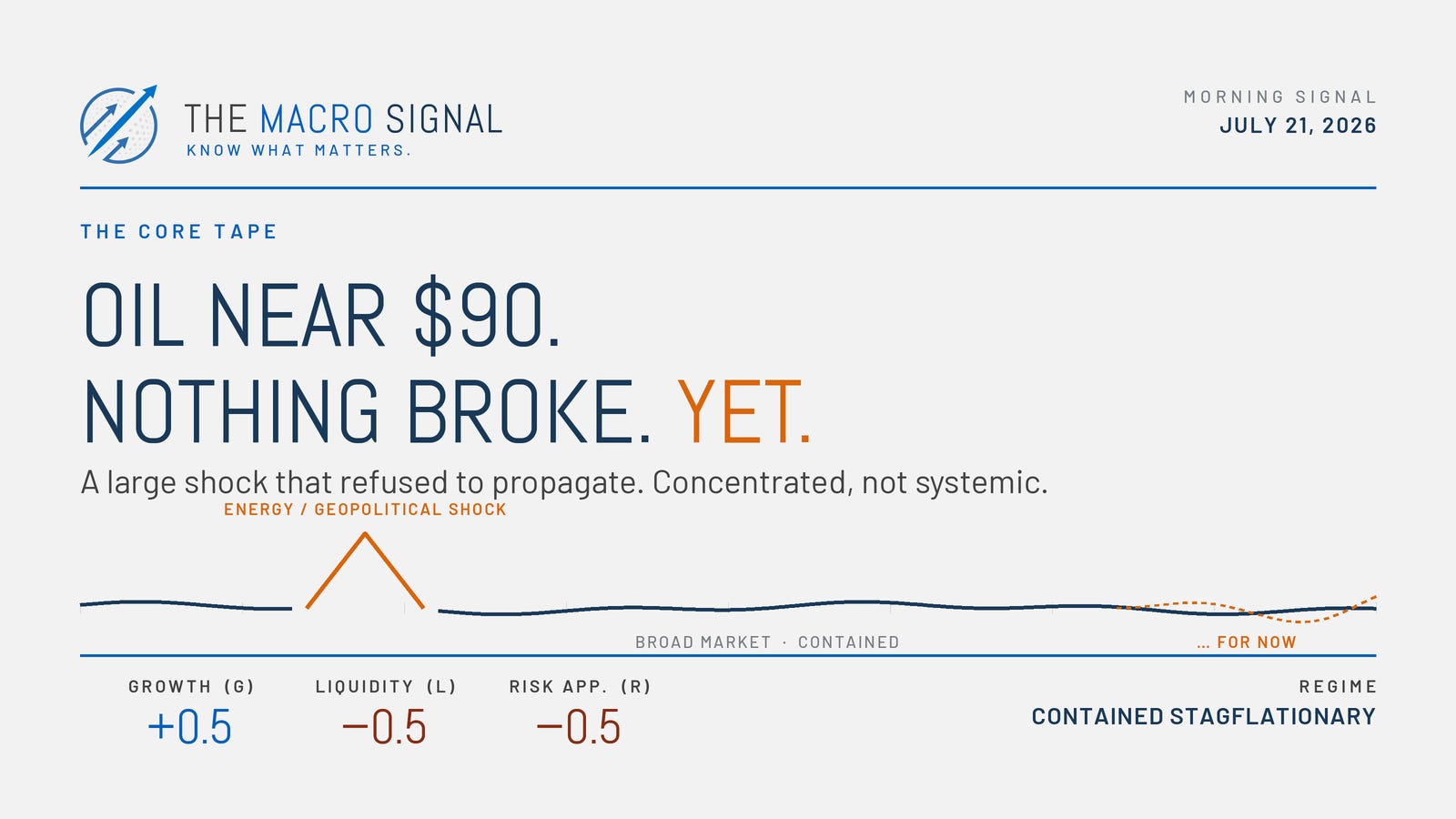
Net-net: Monday was a test of whether the weekend’s escalation would trigger a second leg of broad de-risking. It did not... Equities absorbed another move up in oil with limited index damage, semiconductors tried to find a floor, and the geopolitical premium stayed penned inside physical energy instead of bleeding into broader financial stress. The turbulence is still concentrated, not systemic. It is also not yet resolved…
The Core Tape
Brent briefly traded above $90 before settling just under it. The S&P 500 fell 0.2%, the Dow lost 0.6%, and the Nasdaq gave back an intraday gain of more than 1% to close marginally lower. Three things matter more than the tape itself:
The story wasn’t that oil rose another 1%. It was that a much larger geopolitical premium failed to propagate into broader liquidation of risk assets.
Semiconductors and AI infrastructure tried to stabilize after the prior week’s severe drawdown. Early, and not yet convincing, but the first hint that forced selling may be exhausting.
Physical energy risk still worsened. Tanker-transfer activity in the Gulf of Oman slowed after attacks on vessels, and the Houthi threat to Saudi shipping opens a second disruption channel beyond Hormuz.
Overall: the regime is positive but narrowing growth, neutral-negative liquidity, and impaired but not broken risk appetite. Monday firmed the case that the AI correction is concentrated, not systemic. It did nothing to solve the larger macro problem. The market is absorbing an energy shock without fully repricing the consequences for inflation nor for growth. This leaves the tape exposed to a delayed, second-order adjustment: through rates, consumer margins, earnings expectations, or credit. Posture stays selective, but not overly defensive. Quality and current cash flow over duration; energy and infrastructure over consumer-sensitive cyclicality; relative value over big directional bets.
Top-Down Macro Environment
Growth: Positive but narrowing
Current read. The global economy is still expanding, but the breadth of that expansion keeps narrowing. U.S. activity holds up better than most; housing and the rate-sensitive complex stay weak; Europe faces a more fragile backdrop.
What’s changed. Monday told us investors are not yet treating the energy shock as a growth shock. That is a real distinction. It is not evidence that the consequences are benign. Higher oil feeds into real incomes and margins with a lag, and the lag is the trap.
Confirmation / conflict. Resilient broad equities sit awkwardly against a worsening terms-of-trade shock for every energy importer. The absence of generalized liquidation says the market still expects underlying growth to absorb the hit.
Trading implications. Stay positive but selective. Favor businesses with visible current cash flow and structural demand over anything that needs broad acceleration to work.
Growth (G): +0.5, deteriorating.
Liquidity: Neutral-negative
Current read. Financial conditions are restrictive, but Monday produced no sign of acute stress. The distinction that matters is between expensive liquidity and unavailable liquidity. We are still dealing with the former.
What’s changed. Elevated oil lowers the odds that central banks can answer weaker growth aggressively without first clearing the inflation consequence. The policy put is quietly weaker even before any new inflation prints.
Confirmation / conflict. The energy complex is signaling tighter prospective real conditions; broader markets have not validated any real deterioration in system liquidity.
Trading implication. Keep favoring balance-sheet strength and current cash generation. Long-duration assets can bounce tactically after a violent positioning washout, but the macro still owes them no valuation tailwind.
Liquidity (L): -0.5, stable.
Risk Appetite: Impaired, stabilizing at the margin
Current read. Risk appetite is weaker than a few weeks ago, but Monday gave the first real evidence that the semiconductor unwind may be turning local rather than general.
What’s changed. The Nasdaq was up more than 1% intraday before handing it all back, while several chip and AI infrastructure names bounced off the prior week’s lows. A failed rally is no all-clear. Two-way price action is still an upgrade from one-way liquidation.
Confirmation / conflict. Broad indices held up despite higher oil and continued escalation. The conflict: tech couldn’t hold its early bounce, which tells us supply is still sitting above the market.
Trading implication. Don’t chase the semiconductor rebound, yet. The asymmetry of pressing aggressive shorts is getting less attractive. Price behavior into the upcoming AI earnings will give a far cleaner read. Often times, patience is a virtue that tends to reward the calm and prudent investor…
Risk Appetite (R): -0.5, stabilizing but downside-convex.
Cross-Asset Market Views
Overall market view. Monday reinforced the thesis that the dominant stress is concentrated, not systemic. The open question is which way it resolves: a healthy deconcentration, where old leaders steady and breadth improves, or the rest of the market catching down to higher energy and higher rates.
Level 1: Directional Markets
Monday was neither clean “risk-off” nor a clean relief rally. Oil up, broad equities slightly lower, tech higher before it faded. The tape is still digesting two separate shocks at once: (1) a positioning unwind in AI, and; (2) a physical supply shock in energy.
Equities: stabilization attempt, not a durable turn.
The S&P slipped about 0.2%; the Nasdaq finished marginally lower after trading up more than 1%; the Dow lagged, off 0.6%.
Chip and AI infrastructure names steadied after the prior week’s damage, but the Nasdaq’s failure to hold its rally says investors are still willing to sell strength.
The tell is breadth. Semiconductor stabilization plus improving breadth turns this correction into an orderly rotation. Old leaders rolling over while everything else weakens turns it into generalized de-risking. Watch which one shows up.
Rates: inflation risk is still the binding macro constraint.
The rates question is no longer whether realized inflation is falling. It is whether the energy shock keeps the forward inflation distribution wide enough to stop lower inflation from translating into easier financial conditions.
Key cross-asset signal: if oil holds near here while long yields refuse to fall, the effective discount-rate backdrop stays hostile to expensive equity duration, with or without another Fed move.
FX: terms of trade is the cleaner expression.
The geopolitical shock should keep driving differentiation inside FX rather than a simple directional dollar call. Exporters keep relative support; big importers wear the combination of higher inflation, weaker real incomes, and deteriorating external balances. Trade the terms-of-trade spread, not blanket dollar strength.
Commodities: the premium is real, but capped by physical buffers.
Brent settled at $89.22 after trading above $90, as the market weighed escalating physical risk against fresh talk of negotiations. The point worth sitting with: oil has not moved anywhere near in proportion to the headlines. Crude already in transit and workable alternative routes have capped the scarcity premium even as tanker activity and regional security deteriorate. That sets up a nonlinear payoff. The market is pricing that the system can route around major disruption. Proof that the workarounds are failing would demand a very different price.
Credit and volatility: still no systemic stress.
Equities took Monday’s mix of higher oil and rising geopolitical risk without disorderly selling. That is the central non-confirmation. A true macro liquidation shows up as wider credit spreads, weaker financials, deteriorating breadth, and sticky higher vol. Until those confirm, the weight of evidence favors concentrated stress over systemic de-risking.
Overall regime read: contained stagflationary pressure with localized positioning stress.
Level 2: Cross-Asset Relative Value
What stands out in this tape is the gap between: (A) worsening geopolitical fundamentals, and; (B) still-contained market stress. Monday widened that gap rather than closing it.
Geopolitical risk versus broad risk assets
Observation: oil rose and physical shipping risk climbed, yet broad U.S. equities fell only modestly.
Interpretation: markets are pricing the conflict through the specific cash flows it touches, not through a higher required risk premium across the board.
Confirmation: stable credit and resilient breadth.
Change in view: equities, financials, credit, and growth-sensitive commodities weakening together. That is geopolitical risk migrating into the macro regime.
Semiconductors versus broader technology
Observation: several chip and AI names bounced Monday while the Nasdaq surrendered a gain of more than 1%.
Interpretation: forced selling is turning less one-directional, but there is still no durable clearing price for AI leadership.
Confirmation: chips holding gains on bad news, with improving relative strength. That is seller exhaustion.
Change in view: another failed bounce after strong earnings. That is positioning and valuation still in control.
Oil versus the economic consequences of oil
Observation: Brent is knocking on $90, but broad risk has not priced a matching hit to growth.
Interpretation: the market is separating a geopolitical premium from a persistent macro shock.
Confirmation: stable consumer cyclicals and credit. The economy is absorbing current energy prices.
Change in view: Brent holding materially higher while PMIs, consumer data, and credit soften. That is the handoff from commodity shock to macro shock.
Level 3: Country and Regional Relative Value
The geographic divide is simple: economies that receive the higher energy prices versus those that pay it.
United States: our preferred market regionally, but selectively. The U.S. still owns the best mix of (A) domestic growth, (B) capital investment, and; (C) financial resilience in the developed world. The preference is quality and broad exposure over concentrated long-duration tech. The risk is that higher energy and elevated long yields eventually come weigh down on the consumer at the same time.
Europe: underweight. Europe is the least attractive developed macro combination. Higher energy erodes real incomes and industrial competitiveness while boxing in the ECB. What would change my mind: falling energy prices alongside improving activity surveys and easier conditions.
Japan: neutral. A better domestic cyclical story than Europe, but still exposed to imported energy inflation and an unhelpful currency. The signal to track is whether wage and domestic-demand improvement can outrun the terms-of-trade drag.
Asia: selective, semiconductor risk still elevated. The region pairs heavy AI exposure with imported-energy dependence, which makes this regime unusually hard for semiconductor-heavy markets. China stays differentiated: strong external sector, weak domestic demand. Better to express it targeted than through broad regional beta.
Emerging markets: commodity exporters preferred. The higher-energy regime sharpens the exporter-versus-importer split. The risk is that persistent dollar strength or broader tightening eventually swamps the terms-of-trade benefit. Until then, relative exposure beats broad EM beta.
Level 4: Sector and Style
The rotation toward current cash flow and scarcity beneficiaries remains intact. The semiconductor bounce is the thing to watch: can old leadership steady without forcing energy and the other recent winners to reverse hard?
Leadership: energy, defense, infrastructure, quality. These win on some mix of stronger nominal cash flow, structural fiscal demand, and low dependence on falling discount rates. Energy is the most direct beneficiary of the current regime, but the trade is getting asymmetric: at higher prices the sector gains earnings leverage while the broader economy pays a bigger real-income tax. Quality is the cleaner core exposure. Strong balance sheets and real free cash flow get more valuable as uncertainty rises short of outright recession.
Laggards: semiconductors, speculative growth, housing. Semiconductors tried to stabilize Monday, which is exactly what you watch for after a large unwind. The next tell is whether investors start buying bad news instead of just relieving on good news. Speculative growth stays more exposed because the discount-rate problem hasn’t gone anywhere. Housing has its own constraint: financing costs are restrictive regardless of whether growth stays positive.
Style: quality over duration. This regime rewards businesses whose case rests on cash available today, not terminal values that need materially lower rates. That is not a vote against secular growth. It is a demand for a bigger margin of safety before paying for distant earnings.
Cyclicals versus defensives: selective cyclicals. A preference for nominal cash-flow cyclicals, not a call on economic acceleration. Energy, defense, and infrastructure have direct demand or pricing support. Consumer discretionary, housing, and the other financing-sensitive cyclicals need a better mix of real income and rates than we have yet.
Rate-sensitive assets: cautious. The tactical hurdle is real yields. A sustained fall in real rates without a matching collapse in growth would lift housing, REITs, and long-duration equity meaningfully. Short of that, they stay exposed to the next tightening in conditions.
Thematic
AI and semiconductors: an attempted stabilization, not a confirmed bottom.
The question has shifted from whether the AI investment cycle is real to whether the market has cleared the excess positioning and valuation built on top of it.
Monday’s bounce in several chip and AI infrastructure names was constructive at the margin, but the Nasdaq giving back a gain of more than 1% shows supply is still quite heavy and not yet fully purged.
Upcoming earnings from the large-cap tech complex test whether strong fundamentals can once again buy a positive price reaction.
The most constructive signal would be stabilization in the face of disappointing news.
Change in view: if there were to be repeated failures to hold rallies after strong earnings, then that tells us the correction isn’t done yet.
Energy and geopolitics: physical constraints matter more than headlines.
The market is assuming the global oil system can eat substantial disruption without producing acute scarcity.
Brent briefly cleared $90 before settling just under it, despite further attacks and shipping threats.
Tanker-transfer activity has slowed in the Gulf of Oman, and a potential Houthi blockade of Saudi Red Sea exports adds a second logistical risk.
The catalyst that matters is no longer another hostile headline. It is evidence that physical barrels can’t reach buyers through alternative routes.
Change in view: normalizing tanker activity plus credible negotiations shrinks the premium; a sustained breakdown in physical flows strengthens the stagflation thesis in a hurry.
Consumer: the lagged transmission channel.
The consumer isn’t yet the primary expression of the energy shock. It is where the macro consequence eventually becomes visible. Higher fuel costs cut real disposable income while elevated rates keep squeezing housing and financed consumption. The question is whether upper-income spending and labor income hold up well enough to offset the pressure building underneath. Watch discretionary earnings, retail control, gasoline demand, delinquencies, and consumer confidence.
Defense and infrastructure: structural support intact.
The geopolitical backdrop keeps reinforcing fiscal and strategic investment priorities. These themes lean less on the near-term consumer cycle and ride multi-year spending commitments. The primary risk here is valuation, not demand.
What’s at an Extreme
Semiconductor positioning: the size and speed of the drawdown is unusual next to the absence of any comparable deterioration in underlying AI investment demand.
Oil versus broad-market stress: Brent near $90 has not produced a matching repricing in broad vol or equities. One of the most important cross-asset conditions on the board.
Physical geopolitical risk versus the oil price: the severity of attacks and shipping disruption is unusually high relative to the oil response, which says the market still credits large logistical workarounds.
Equity concentration: former leadership stays exposed while broad indices haven’t taken comparable damage.
Real-rate pressure: restrictive real yields plus elevated long-duration valuations leave parts of the equity market unusually sensitive to small moves in discount rates.
What’s Moving in an Extreme Way
Semiconductors: after the prior week’s severe decline, Monday was the first real stabilization attempt. The shift from one-way liquidation to two-way trade matters, but it isn’t a bottom.
Oil: Brent poked back above $90 as escalation continued, though the small closing gain shows physical buffers still restraining the scarcity premium.
Shipping risk: the disruption is broadening from Hormuz itself into tanker transfers and possible Red Sea routes, which raises the weight on physical-flow data over rhetoric.
AI relative momentum: the sharp break of recent weeks is still intact despite Monday’s bounce. Earnings reactions are now the test of whether it is stabilizing or rolling into a second leg.
Watch Next
Brent >$95+: a sustained break raises the odds that energy becomes a broad macro shock rather than a contained premium.
Semiconductor price reactions on good news: failing to rally on strong earnings signals unresolved supply and more valuation compression. Holding gains on bad news is the stronger bottoming tell.
High-yield credit: material spread widening is the cleanest confirmation that equity stress is migrating into broader conditions.
Market breadth: improving breadth with stable semis supports an orderly rotation; both weakening together signals generalized de-risking.
Global flash PMIs: new orders versus input prices is the pair. Falling orders with rising prices is the clearest stagflation confirmation.
Physical oil flows: tanker traffic, shipping insurance, loadings, and alternative-route utilization matter more now than the next escalation headline.
Long-end yields: higher yields with higher oil reinforce the inflationary read; a sustained Treasury rally despite firm oil says growth fear is taking over.
AI earnings and capex guidance: the numbers matter, the reaction matters more. Whether strong results can restore leadership decides whether this was positioning or the start of an expectations reset.